Blog

  • EFCC recovers N1.23trn, secures 10,872 convictions in 34 months

    EFCC recovers N1.23trn, secures 10,872 convictions in 34 months

    The Economic and Financial Crimes Commission (EFCC) has recorded 10,872 convictions and recovered over N1.23 trillion in cash and assets in the last 34 months, its chairman, Ola Olukoyede, said. Olukoyede disclosed this at a media interactive session to mark his three-year stewardship at the commission’s headquarters in Abuja on Monday.

    He described the period between October 2023 and July 2026 as a “period of sustained enforcement, institutional reform, prosecution, asset recovery, restitution and stronger collaboration at home and abroad.” The EFCC boss recalled that at his confirmation by the National Assembly, he outlined a three-pronged agenda focused on the commission’s mandate, using the anti-graft war to stimulate economic growth and adherence to the rule of law.

    He said that “to the glory of God, we have kept faith with the agenda of proper focus on the mandate of the EFCC in the overall interest of Nigerians. He said, “asset recovery has been another major pillar of our stewardship. “Between Oct. 1 2023 and June 30, 2026, the commission recorded recoveries of N1, 233,612,040,411.11, $684.478,457.32, £373,905.78, €9,343,803.66 in addition to recoveries in other currencies. “Of the naira amount, approximately N397.26 billion (33 per cent) represented direct recoveries for the Federal Government.

    “Also, N836.34 billion (67 per cent) represented indirect recoveries made on behalf of Ministries, Departments and Agencies (MDAs), state revenue services, companies, individuals and foreign victims. “Two out of every three naira recovered were on behalf of beneficiaries other than the Federal Government.” According to him, recovery is only truly meaningful when value is returned to the public interest and to the rightful beneficiaries.

    “During the period, N661.32 billion and 492.37 million U.S. dollars were released to beneficiaries. The naira releases included about N325.35 billion, paid directly to individuals and corporate bodies.


  • The regulatory quagmire stifling Francophone Africa’s startups

    The regulatory quagmire stifling Francophone Africa’s startups

    1 septembre 2026 Hello , Welcome back to Francophone Weekly by TechCabal, your weekly deep dive into the tech ecosystem across French-speaking Africa. For readers who want to understand Francophone Africa beyond headlines—through markets, startups, and systems. New editions of the newsletter will land directly in your inbox every Tuesday at 12 PM WAT. By default, this newsletter is in French.

    If you’re reading this in your email inbox, click the “Read in English” button below to switch to the English version. If you’re reading on our website, you can either click the button below or toggle the language selector at the top right-hand side of the page to view the English edition. Please note that today’s edition is a re-run of an edition from November 2025.

    Read in English Le secteur des start-ups africaines regorge de potentiel, et l’Afrique francophone est en passe de devenir la nouvelle coqueluche du continent, grâce à des devises qui restent relativement stables par rapport à celles des grandes économies du continent. Pourtant, les entrepreneurs d’Afrique francophone sont toujours confrontés à des réglementations obsolètes et à une inertie bureaucratique qui ralentissent les progrès.

    La réalité sur le terrain pour ces fondateurs est une lutte acharnée contre des systèmes qui semblent conçus pour entraver le progrès. Aujourd’hui, une nouvelle évolution entre le Ghana et le Rwanda met la région à l’épreuve.

    Lors du FinTech Forum qui s’est tenu à Kigali il y a quelques mois, la Banque du Ghana (BoG) et la Banque nationale du Rwanda (NBR) ont signé le premier accord africain de passeportage de licence, permettant aux fintechs agréées dans l’un ou l’autre pays d’opérer sur les deux marchés avec un minimum d’autorisations supplémentaires.

    Cette initiative pourrait enfin rendre les paiements transfrontaliers interopérables et plus fluides entre les deux pays. Examinons le cas

  • BBNaija 11: Aikou, Flora face possible loss of Gambit status

    BBNaija 11: Aikou, Flora face possible loss of Gambit status

    Big Brother Naija Season 11 has introduced a new twist that could see Gambits Aikou and Flora return to the main competition following a viewers’ poll announced during Sunday’s live eviction show. Recall that Aikou and Flora were unveiled as this season’s “Gambits” in the second week of the reality show, with host Ebuka Obi-Uchendu revealing that they were no longer eligible to compete for the ₦160 million grand prize.

    Instead, they remained in the house as Biggie’s agents, carrying out secret tasks and helping shape events behind the scenes. However, during Sunday’s live eviction show, Ebuka announced the “Operation Release the Gambit” twist, giving viewers the power to decide the fate of the two housemates. Viewers will vote on three options: release Aikou back into the game, release both Aikou and Flora into the game or release Flora into the game.

    The outcome of the poll will determine whether Aikou, Flora or both housemates will regain eligibility to compete in the reality show. The development adds another layer of suspense to the Season 11 competition, with viewers now holding the power to determine whether the two Gambits return as full contestants. BBNaija Season 11, themed ‘Show Ya Sef’, premiered on July 26, 2026, with housemates competing for a grand prize of ₦160 million. Vanguard News

  • Bishop David Richman Olayinka on his Episcopal Consecration!

    Bishop David Richman Olayinka on his Episcopal Consecration!

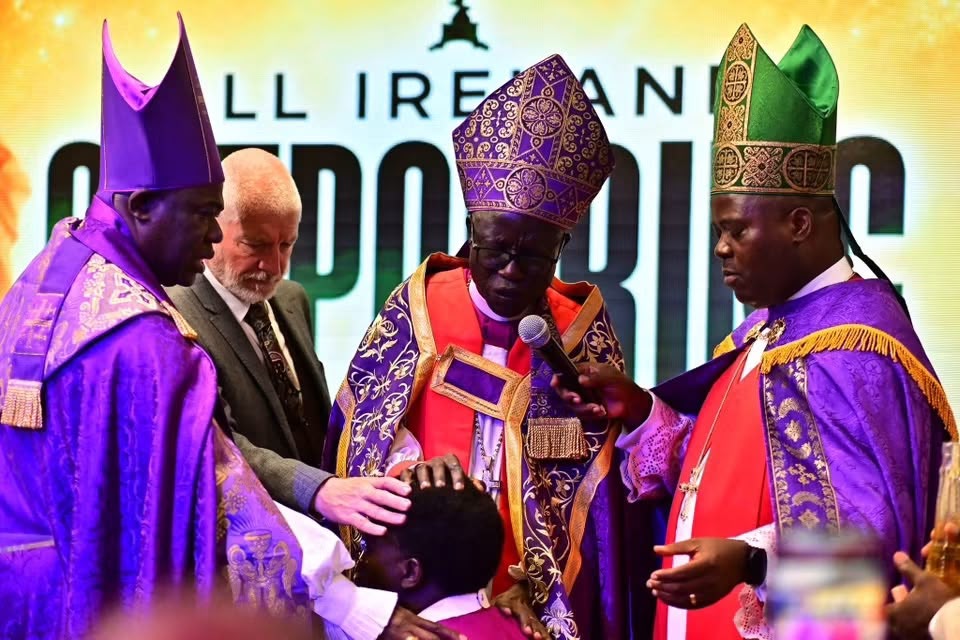
    A historic and glorious moment in Ireland (Europe) on the 15th of August, 2026 with Bishop Francis Wale Oke! We joyfully celebrate and congratulate Bishop David Richman Olayinka on his Episcopal Consecration! What a testimony of God’s grace and faithfulness. As the first Black Pentecostal Bishop in Ireland, this is a significant milestone and a reminder that God is still raising leaders, breaking barriers and advancing His Kingdom across generations and nations.

    “Before I formed you in the womb I knew you; before you were born I sanctified you; I ordained you…” — Jeremiah 1:5 “For promotion comes neither from the east, nor from the west, nor from the south. But God is the Judge: He puts down one, and sets up another.” — Psalm 75:6–7 Bishop David, we celebrate the call of God upon your life and the grace that has brought you to this moment.

    May the Lord continue to enlarge your territory, strengthen your hands and use your ministry to impact Ireland, the nations and generations to come. Congratulations, Bishop David Richman! May this new chapter be filled with greater grace, greater influence and greater fruit for the glory of Jesus Christ. Save my name, email, and website in this browser for the next time I comment.

  • 'If you started running, they shot you' – inside Nigeria's growing kidnapping crisis

    'If you started running, they shot you' – inside Nigeria's growing kidnapping crisis

    Fatima says her husband and six of his siblings were killed when bandits attacked "If you ran into a room, they set the room on fire," says Fatima, describing a recent attack on her village in Zamfara, north-western Nigeria. "If you came out and started running, they shot you." The gunmen, who struck at 02:00, split into groups to surround residents: one at the village entrance, one in the centre and one at the back.

    "They opened fire without a care in the world, shooting indiscriminately," the 55-year-old quietly tells the BBC World Service. It was one of many attacks that have caused havoc in the mainly Muslim community where residents live in fear of being kidnapped for ransom.

    Fatima explains how the raids unfold: "You could have 100 motorcycles, and each one could be carrying three people." About 70 people, including children, were killed from the village of Bia Buki in June, according to Fatima. She describes how the attackers also targeted villagers as they fled and children were injured falling into ditches. Among the dead were her husband and six of his seven siblings.

    Fatima is one of an estimated 800,000 Nigerians who the UN says have been displaced in the country's north-west. One of the main reasons people have left their homes is violence. Some attacks have been carried out by militant Islamist groups, but the majority in this region are by gangs, locally referred to as bandits, who often move around on motorcycles and attack quickly then ride away, escaping before security forces arrive.

    Thousands of people have joined government-backed vigilante groups to fight, and the BBC spoke to one who said his armed group had killed many bandits. But the gangs keep attacking in what appears to be a deteriorating pattern of violence and abductions

  • Pathology crisis: Nigeria has less than 200 specialists for 200m people

    Pathology crisis: Nigeria has less than 200 specialists for 200m people

    …Pathologists demand urgent investment as brain-drain, poor working conditions threaten cancer careBy Chioma Obinna Nigeria has fewer than 200 practising pathologists serving a population of more than 200 million people, a development experts say is threatening accurate diagnosis, cancer care and the wider health system.

    The specialists, who described pathology as the bedrock of modern medicine, warned that the country could face a deeper diagnostic crisis unless government urgently invests in training, infrastructure, technology and incentives to retain specialists. Speaking in Lagos at the 16th Annual General Meeting and Scientific Conference of the West African Division of the International Academy of Pathology, WADIAP, tagged EKOPATH ’26.

    The three-day conference, which began on August 24 to 26th, has as its theme: “Future-Proofing Pathology in West Africa: Integrating Quality, Innovation, and Regional Synergy.” Speaking, President of WADIAP, Prof. Fatimah AbdulKareem, said current statistics showed that fewer than 200 pathologists were practising in Nigeria, with the situation worsening as young doctors showed little interest in pathology training and qualified specialists migrated abroad.

    According to her, Nigeria had at some point trained about 800 pathologists, but the number currently practising in the country was far below that figure. “Right now in the country, the number that are in the country now, by the time we take the statistics, it may not be up to 200 pathologists that are left in the country,” she said. AbdulKareem said the country was facing a dangerous combination of inadequate recruitment and migration.

    She cited the experience of Lagos University Teaching Hospital, LUTH, where an advertisement for residency training reportedly attracted only two interested applicants, yet none eventually resumed the programme. “Secondly, the ones that we are training, as they finish, as they qualify, they leave. Because they can easily get a job outside the country,” she said. The

  • Martins: Osimhen Needs Strong Competition In Eagles

    Martins: Osimhen Needs Strong Competition In Eagles

    Former Nigerian international Obafemi Martins has disclosed that the Super Eagles need to develop another top striker to give Victor Osimhen direct competition, just as he had to fight for his place against Yakubu Aiyegbeni during his playing days. Speaking on The Obi One Podcast, Martins noted that the team rely too heavily on Osimhen and require an alternative and reliable forward to push for the starting spot.

    Recalling his era in the national team, he mentioned competing alongside strong forwards like Yakubu Aiyegbeni, Osaze Odemwingie, and Julius Aghahowa, where starting spots were earned through intense competition without personal animosity. “You need someone that is going to compete with all the players, not just Osimhen. “My own time, we had Yakubu there. If Yakubu starts the game, I’ll be on the bench waiting.

    “I know if he’s out and I score, I’m going to start the next game. We’re always like that. We don’t hate each other because of that.” Martins also defended Osimhen’s fiery on-field attitude, explaining that his intense passion should not be mistaken for a bad character. “You cannot keep him quiet.

    I think that’s what is keeping him going as well because the way he behaves does not mean he has a stinking attitude. That’s how he can play, so the majority of people don’t understand that. “Seeing him is a blessing in the national team as a Nigerian.

    We should try to make him happy and let him score more goals.” He already has competition but the so called midfieders say they only play to fit into VO9 playing style. Ridiculous to hear that.. Spain won the world cup without a proving or world class striker.

  • Mo Bimpe & Lateef Adedimeji Stepped Out in Stunning Burgundy Looks for Their Triplets’ Thanksgiving

    Mo Bimpe & Lateef Adedimeji Stepped Out in Stunning Burgundy Looks for Their Triplets’ Thanksgiving

    Stepping out in coordinated style, Lateef Adedimeji and Mo Bimpe admire each other’s custom Zackstyling Luxury outfits ahead of their triplets’ thanksgiving event in Lagos. When you pray for something and yearn for it for so long, and then it finally happens after years of waiting, it is only natural to throw a party, paint the town red, and dance with everyone you love in celebration of what you have received.

    Oh, if you’re wondering what we’re talking about, it’s the thanksgiving celebration of Lateef Adedimeji and Mo Bimpe. The Nollywood couple held a thanksgiving party to celebrate the arrival of their triplets, and while we cannot wait to bring you all the highlights from the celebration, especially the guest fashion, we need to start with their first look because it was colourful, regal, and perfectly suited for the occasion.

    A quiet, tender moment between Nollywood couple Lateef Adedimeji and Mo Bimpe as they showcase their custom burgundy traditional outfits by Zackstyling Luxury for their triplet sons’ grand thanksgiving celebration. Following the arrival of their three boys—Rahman, Raheem, and Rakeeb—which the couple announced on 1st May 2026, , actor Lateef Adedimeji and actress Adebimpe Oyebade (famously known as Mo Bimpe) hosted family, friends, and colleagues to celebrate their triplets.

    Styled by Zackstyling Luxury, the new parents chose a striking, coordinated burgundy palette that immediately set the celebratory mood for the day. A closer look at the craftsmanship behind the Adedimejis’ first look, highlighting the geometric embroidery on Lateef’s Agbada and the beaded, floral-detailed gown worn by Mo Bimpe. Lateef Adedimeji made a stately appearance in a rich burgundy Agbada featuring off-white geometric chest embroidery, paired with a matching Fila tilted to the side.

    He completed his look with multiple long strands of traditional coral beads draped around his neck and

  • The cost of governing in election cycles instead of economic cycles

    The cost of governing in election cycles instead of economic cycles

    Nigeria has two clocks. One counts down to elections. The other counts forward to prosperity. The first moves in four-year intervals. The second move in decades. Much of Nigeria’s economic frustration may come from trying to make the second obey the first. Consider what the economy actually requires. A child entering school today may not become a productive worker for another 15 or 20 years.

    An industrial investment may take a decade before it creates an ecosystem of suppliers, skilled workers and exports. Infrastructure can take years before its full economic value becomes visible. Politics does not have that patience. A government has four years to prove itself. A politician must show results before voters return to the ballot box.

    The temptation is therefore obvious: prioritise what can be completed, announced or commissioned within a political tenure over what may produce its greatest economic return after that tenure has ended. “A government can inherit the pain of a reform without inheriting its eventual reward. Its successor may inherit the benefits. The political incentive, therefore, can quietly favour interruption.” That is where the incentives begin to diverge. Politics rewards visibility. Development rewards continuity.

    Nigeria’s current economic moment makes the distinction especially important. The country has undertaken some of its most consequential economic reforms in years. The IMF says the reforms have strengthened macroeconomic stability and resilience and projects real GDP growth of 4.1% in 2026. Yet Nigeria is now entering another electoral period while those reforms are still working their way through the economy. This creates a difficult political question.

    What happens to a reform when its costs are immediate, but its benefits belong to the future? That is the problem with economic time.

  • Nigeria wants crypto firms to lock up 80% of customer assets offline

    Nigeria wants crypto firms to lock up 80% of customer assets offline

    This is Follow the Money, our weekly series that unpacks the earnings, business, and scaling strategies of African fintechs, financial institutions, companies, and governments. A new edition drops every Monday. When you buy cryptocurrencies such as Bitcoin or Ether on a local exchange, you are often trusting the platform with one simple task: to keep your funds safe. But what happens if the exchange is hacked, freezes withdrawals or suddenly shuts down?

    Nigeria’s Securities and Exchange Commission (SEC) wants cryptocurrency companies to have better answers. Under proposed rules released on August 20, crypto exchanges and other digital asset firms would have to separate customer funds from their own, strengthen how they safeguard cryptocurrencies, and report major losses, cyber incidents, and other material operational failures to the regulator.

    The framework, which is open for public comment, brings a rule already familiar in the traditional banking sector to the digital asset industry: when something goes wrong, the regulator expects to know about it quickly. Like banks, crypto firms would have to notify their regulator of certain incident reporting within 24 hours with further updates where necessary; the SEC’s proposal also requires digital asset firms to submit a detailed incident report within 48 hours.

    The SEC is also proposing higher financial requirements for digital asset businesses. Digital Asset Exchanges and Digital Asset Custodians (DACs) would each need minimum paid-up capital of ₦2 billion ($1.5 million) while Digital Asset Platform Operators (DAPOs), Digital Asset Offering Platforms (DAOPs), and Real-World Asset Tokenisation Platforms (RATOPs) would require ₦500 million ($371,600). Virtual Asset Service Providers would require ₦200 million ($149,000). The proposal also requires a current fidelity insurance bond covering at least 25% of the applicable minimum paid-up capital.

    The rules are aimed at strengthening investor protection and reducing the risk that customers lose access to their